
Personal loan debt consolidation is back in the spotlight. With record personal loan balances and stubbornly high revolving APRs, many borrowers are asking the same question: is personal loan debt consolidation still safe in 2025—or are we just reshuffling debt? This guide explains the market backdrop, when consolidation helps, and 9 smart checks to keep you safe.
Why personal loan debt consolidation is trending in 2025
- Personal loan balances have reached new highs as lenders reopened “buy boxes” and consumers seek predictable fixed payments (rather than floating card APRs).
- Household credit stress is uneven: revolving debt costs remain elevated, while installment loans offer clearer payoff dates.
- The core promise of consolidation in 2025: swap multiple high-APR revolving balances for one fixed-rate installment with a set end date—if the numbers truly work.
When is personal loan debt consolidation still safe?
Choose consolidation if ALL are true:
1) Your quoted fixed APR + fees is meaningfully lower than your weighted (“blended”) credit card APR over the same payoff horizon.
2) Payment fits your budget after essentials (housing, food, transport, insurance).
3) No new card spending until the loan is paid down (freeze cards if needed).
4) No prepayment penalty and you plan to route windfalls to principal.
If any of these fail, look at a nonprofit DMP or a short budget reset before applying.
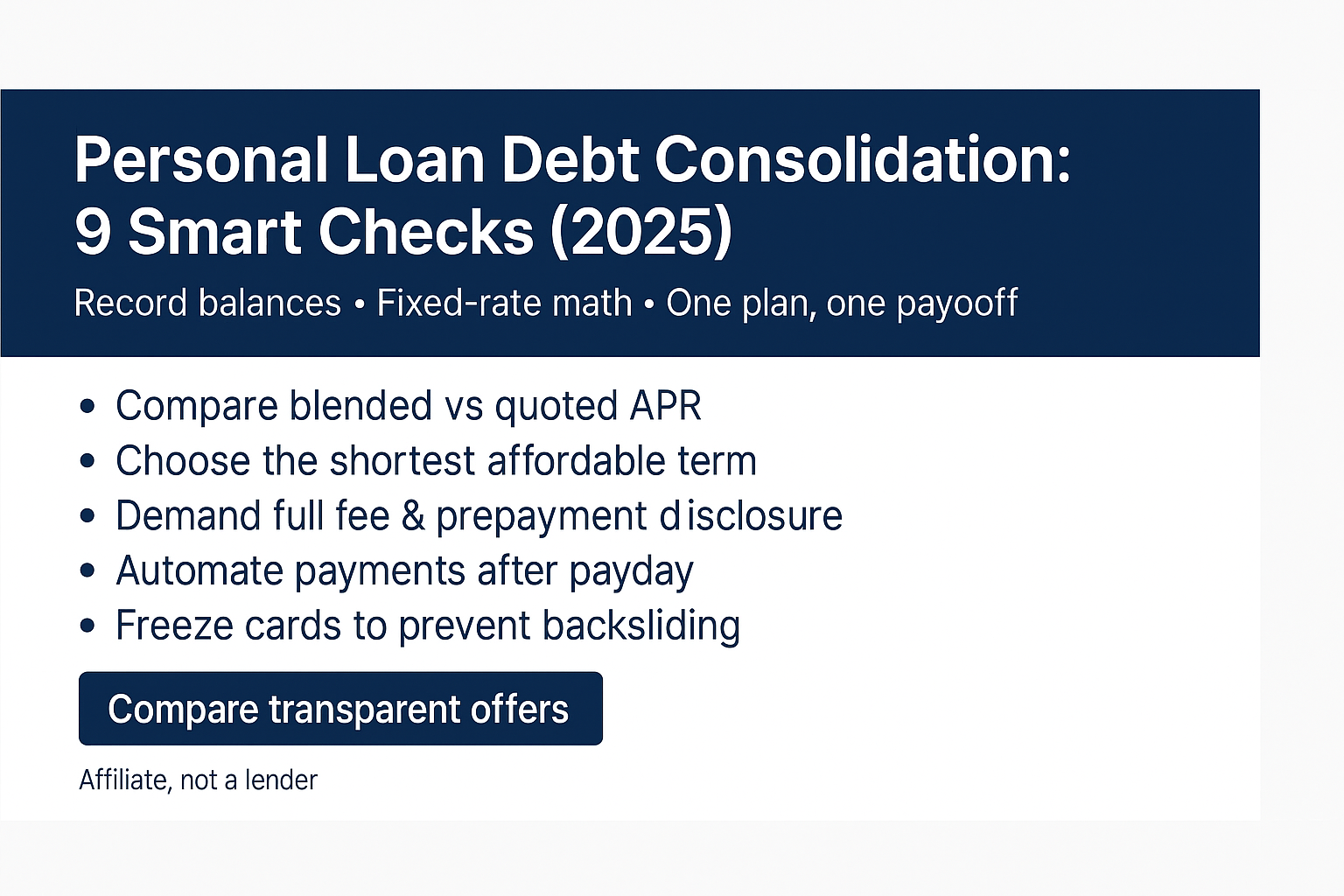
9 smart checks before you consolidate with a personal loan
1) Compute your blended APR across cards; compare to the loan’s APR including origination fees.
2) Pick the shortest affordable term. Shorter terms raise the monthly bill but slash total interest.
3) Demand transparency: APR, total cost, payment schedule, late fees, and prepayment rules in writing.
4) Stress-test your cash flow. Could you make payments if income dips or an expense spikes for 2–3 months?
5) Avoid add-ons (credit insurance, “expedite” fees) unless you truly need them.
6) Automate payments the day after payday; set calendar nudges before due dates.
7) Prevent backsliding: lock cards you’re consolidating; remove them from wallets; delete autofill.
8) Monitor credit mechanics: installment utilization isn’t scored like revolving; on-time history helps, new hard inquiries may cause a small, temporary dip.
9) Recalc after extra payments. Track your updated payoff date every time you send principal.
Is it still cheaper in 2025? (How to do the math)
- Use a loan calculator to compare total interest + fees on the personal loan vs status-quo interest on your cards over the same number of months.
- If the loan’s total cost is lower, and you won’t re-borrow on cards, consolidation likely helps.
- For intuition on how each payment reduces principal vs interest, see How Amortization Works.

Personal loan vs balance transfer vs DMP (2025)
- Personal loan (fixed-rate): Predictable payment and end date; best when your quoted APR (plus fees) beats your blended card APR.
- 0% balance transfer: Can be excellent if you can clear the balance before promo ends; watch transfer fees and “revert-to” APR.
- Debt Management Plan (nonprofit): If your quotes are too high or approval odds are low, a DMP may reduce rates and structure payments without a new loan.
Risks that make consolidation unsafe
- Long terms that shrink the payment but balloon total interest.
- High origination fees that erase savings.
- Continuing to swipe on the same cards after consolidating (double debt).
- Missed payments (late fees + credit damage).
Staying safe in a record-balance environment (2025 context)
Market data show unsecured personal loan balances at record levels and revolving credit costs still elevated. That mix makes discipline essential: shop multiple quotes, keep terms short, and lock cards post-funding. One plan. One payoff. No new debt.
We’re an affiliate, not a lender. Compare transparent offers that publish APR, fees, and terms. Choose the shortest affordable fixed rate that beats your blended APR, automate payments, and track your debt-free date. For budget guardrails and habit fixes, see How to Budget and Save Money and Debt Consolidation for High-Interest Loans.
New York Fed HHDC Q3 2025 (household debt context, credit cards & “other” balances)
FRED (Fed G.19) 24-month personal loan rate (latest monthly value)